

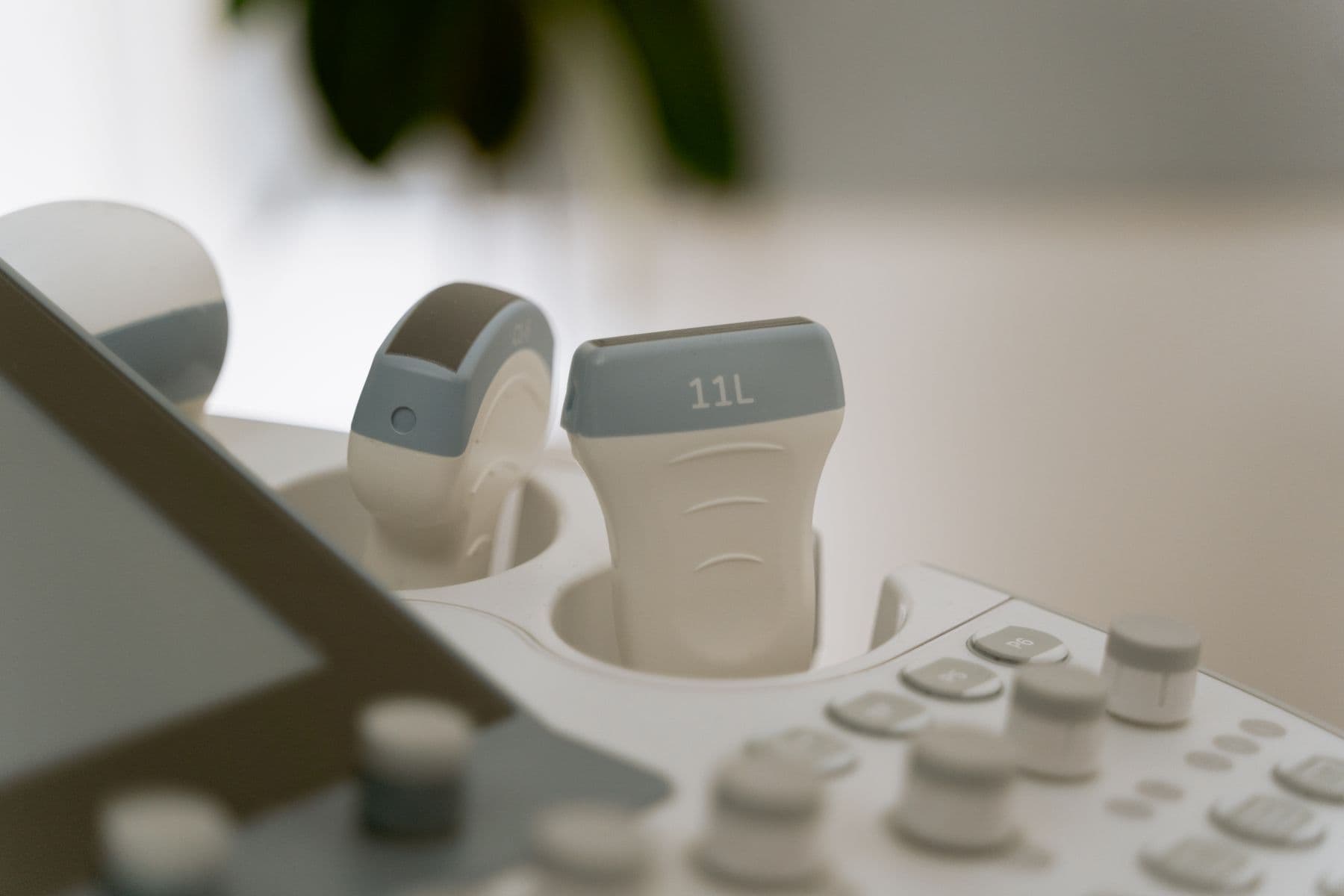
Diagnostic test
Carotid and transcranial Doppler
Carotid and transcranial Doppler are painless ultrasound tests of the blood vessels that supply the brain. The carotid Doppler examines the arteries in the neck, and the transcranial Doppler (TCD) the arteries inside the skull. Together they give a real-time picture of blood flow from the heart into the brain and help evaluate stroke risk, dizziness and fainting.
What are these tests?
A safe ultrasound study of the blood vessels that supply your brain. It has two complementary parts that work together:
Carotid Doppler
Examines the arteries in the neck, the carotid and vertebral arteries, that carry blood up to the brain.
Transcranial Doppler (TCD)
Examines the arteries inside the skull, using ultrasound that passes through natural “windows” in the bone.
Together they give a real-time picture of blood flow from the heart, through the neck and into the brain. TCD can also be combined with a bubble study to look for a shunt such as a patent foramen ovale.
Why might your doctor order them?
- Dizziness, vertigo or balance problems
- Fainting or near-fainting (syncope or pre-syncope)
- Vision changes: blurring, partial loss or double vision
- Numbness, weakness or difficulty speaking
- Memory loss or changes in thinking
- Headaches with a vascular component
- Persistent symptoms after a concussion or head injury
- Long COVID with cognitive or cerebrovascular symptoms
- Stroke or TIA (transient ischemic attack) risk evaluation
- Follow-up after carotid surgery or stenting
What should you expect?
Before
No preparation is needed in most cases. Take all medicines as usual. Wear a top with an open neckline and remove any neck jewelry. If your test measures how your vessels respond to a challenge, our office will tell you in advance whether to avoid caffeine, nicotine or certain medicines.
During
You lie or sit comfortably while the sonographer applies warm gel to your neck, the sides of your head and behind your ears, then moves a small handheld probe over the skin. You may be asked to hold your breath, breathe deeply, turn your head, change position or have a blood pressure cuff briefly inflated on your arm. These short, painless maneuvers show how your blood vessels respond.
After
The gel wipes off easily. Resume all normal activities immediately, with no recovery time and no driving restrictions.
Most studies take 30 to 60 minutes.
What can the tests show?
In the neck arteries
- Plaque and the degree of narrowing
- Early signs of atherosclerosis
- Abnormal flow direction, such as subclavian steal
In the brain arteries
- Flow speed and direction
- Narrowing or blockage inside the skull
- How the vessels respond to challenges
- Small particles (emboli), when present
The findings inform stroke prevention, the evaluation of dizziness and fainting, and follow-up after treatment.
I already had a carotid Doppler
One of the most common questions we hear, and an important one.
- A more comprehensive scope. Most outside studies examine only the neck arteries. We also evaluate the arteries inside the skull, where many causes of stroke and dizziness are found.
- It tests how your vessels respond. Breath-holding and position changes measure how the vessels work. A standard duplex study is a static snapshot.
- Read by a neurologist. Your study is interpreted by a neurologist focused on brain blood flow, not surgical anatomy.
- Blood flow can change within months, especially with new symptoms or risk factors.
A normal outside carotid study does not rule out a problem inside the skull, or one that only appears when the vessels are challenged.
Is it safe?
Among the safest tests in medicine
Yes. Carotid and transcranial Doppler use:
- No radiation
- No contrast or injected dye
- No needles, unless a bubble study is also planned
- No known side effects from the ultrasound itself
- Safe in pregnancy and in children
- The same ultrasound technology used to image babies during pregnancy
These tests are used routinely in clinics, hospitals and intensive care units worldwide. If you have ever had an obstetric ultrasound, you have already experienced this technology.
How long does it take, and where is it done?
- How long it takes
- About 45 minutes
- Where
- Walnut Creek and Vallejo
- Insurance
- Coverage depends on your plan. Please check with your insurance company.
 East Bay
INPM Walnut Creek
301 Lennon Lane, Suite 203Walnut Creek, CA 94598
- Wed and Fri
- 8:00 AM – 5:00 PM
- Sat
- 9:00 AM – 3:00 PM
 North Bay
INPM Vallejo
155 Glen Cove Marina Rd, Suite 100Vallejo, CA 94591
- Mon, Tue and Thu
- 8:00 AM – 5:00 PM
Questions
Frequently asked questions
01I already had a carotid Doppler. Why repeat it?
Most outside studies examine only the neck arteries, while INPM also evaluates the arteries inside the skull, where many causes of stroke and dizziness are found. The study also tests how your vessels respond to breath-holding and position changes, and it is read by a neurologist focused on brain blood flow. Blood flow can also change within months, especially with new symptoms or risk factors.
02Do I need to prepare for a carotid or transcranial Doppler?
No preparation is needed in most cases. Take all your medicines as usual, wear a top with an open neckline and remove any neck jewelry. If your test measures how your vessels respond to a challenge, our office will tell you in advance whether to avoid caffeine, nicotine or certain medicines.
03Do these ultrasounds use radiation?
No. They use sound waves, with no radiation, no contrast dye and no needles. They have no known side effects and are safe in pregnancy and in children.
Referral required
Start with a referral from your doctor
New patients are seen by referral. Your primary care physician can fax the referral to (707) 980-6692 or send it through EPIC, and our office will call you to schedule.
- Referral fax (707) 980-6692
- EPIC referral
- We call you to schedule